My Manifesto
I create space for people to meet themselves more honestly — in their emotions, their relationships, and the way they live.
If you’ve found yourself here, you may have reached a point where familiar ways of living, working or relating no longer fit, yet the next step isn’t clear. You sense your own potential, but find yourself circling the same patterns, looking for a different way forward.
This site offers articles, meditations, and practical resources to support reflection and self-inquiry. They’re here to help you notice patterns, question familiar responses, and see yourself with a little more clarity and kindness.
Deliberately, there is no explicit structure for you to follow or clearly defined sections. There is no linear sales funnel where all roads lead to buying something, although I do have offerings which you might be interested in.
Think of it as a sandbox where you get to explore. Your journey through these pages is yours to choose. They may appear random, yet they’re linked by what it means to be human. They are a reflection of what I’ve learned and experienced in my own transformation and through trainings, and they shape how I work with people.
Contents
You can explore or jump directly to a topic that resonates:
- Jack of all trades, master of some
- Work, Identity, and Perfectionism
- Uncertainty and Better the Devil You Know
- Love, Intimacy, and Pattern
- Family Systems and Intergenerational Threads
- The Body as a Doorway
- Yoga as a Path to Healing
- Integrating our Energetic Polarities
- Healing, Avoidance, and Spiritual Bypassing
- Stillness, Movement, and Restlessness
- Teachers, Mentors, Community
- The Best Part of It All?

Jack of all trades, master of some
I have always been a generalist in everything I’ve done. I was self-conscious about not having deep expertise in a specific area; now I embrace the range I have and the expansiveness of my own journey. Over time, I’ve come to trust that range as a way of meeting complex situations as they are, rather than trying to force them into a single explanation or approach.
As this digital world expands, my wish is that you find something that resonates with your own story, something that feels useful. Feel free to skip anything that you feel less connected to.
I love hearing perspectives that empower me to make my own choices — and what you’ll find here is offered in that same spirit. If you want to connect, feel free to get in touch at any time. I read every message.
Work, Identity, and Perfectionism
I worked as a lawyer at international law firms in London, Mexico City, and San Francisco. I enjoyed those jobs and learned from very intellectual individuals who had reached the pinnacle of their profession.
I’ve spent a while reflecting on those chapters in my life, and I’ve discovered a lot about my struggles with perfectionism and how industries like law and finance — and the world at large — encourage perfectionism to the point where we feel exhausted by it.
The quiet, creeping exhaustion of constantly holding ourselves together is something I know well, and it’s something many people recognise long before they know what to do with it.
The more productive we are, the more external validation we receive. Yet when we use that validation to propel us forward — to replace a sense of self we never really had space to develop — it’s like filling a bucket of water with a hole in it. No amount of praise or recognition is ever quite enough, so we work ourselves into the ground hoping for some respite and satisfaction that arrives, briefly, and then disappears again. If any of this feels familiar, you’re not failing — you’re noticing something important.
We identify with achievement. If we were the golden child or the star kid in our families, we learned early that our abilities and our school prizes fed the rest of the family. Our A*s made our parents and grandparents noticeably happier. They bragged to their friends about us. We absorbed the message that achievement would yield us more love and approval. That belief never really went away, and years later we - and our loved ones - can’t quite understand why we keep pushing ourselves to burnout.
It's like living in a constant state of fight or flight. The tiredness is not the "I went to bed too late" type; it's a more profound sense of needing to take a break, get off the hamster wheel, and hibernate for a little while. Technology and AI automate certain tasks in most industries, but this is not enabling us to work less or go slower. Quite the opposite.
The way the corporate world is structured rewards workaholism. We become addicted to work and the chaos of it all. Dialling into calls at 3am. Pulling all-nighters to get the job done. Impressing our bosses. Staying busy enough not to feel. Proving ourselves to ourselves and others.
The more we work, the more we are esteemed by our employers and peers, the greater the financial rewards.
Meanwhile, we are conveniently able to ignore the deep anxiety, fear and emptiness underneath it all.

Uncertainty and Better the Devil You Know
So we’ve realised the patterns and stopped drinking the Kool-Aid. Or at least we’ve started to question it. Now what?
Noticing the patterns is an important first step — and if you’re here, you’ve probably already taken it, even if you don’t quite know what to do with it yet.
That doesn’t have to mean quitting straight away or blowing everything up. Often the first shift is subtler. Through noticing our behaviours, we can start to relate differently to the exact same job. Our difficult boss hasn’t changed, but we take their criticism less personally. Their feedback feels less like an indictment of our character.
We begin to see how much of the achiever in us is wrapped up in job titles, prestige, and perks. We start to relate differently to our inner critic. Letting go of that identity — or allowing it to soften so it no longer runs the show — takes work.
We go deeper and begin to understand what the profession actually gave us: routine, safety, belonging, validation. Perhaps the high-achieving child is still, to some extent, driving the bus. Seeing that clearly, and beginning to listen to that child part of us, is often the first real shift.
At some point, a different realization may emerge. We might see that while we’re good at our jobs and they pay the bills, we don’t actually like where the path seems to be heading, and we can’t picture ourselves staying on it long-term. There may be another role asking to be lived — something that feels more honest, even if it’s less obvious or less financially rewarded.
Seeing that doesn’t automatically make it easier to leave. In fact, it often brings a new kind of fear. It took me years to leave my law firm job from when the idea first arose. Letting go of a path we understand — one that comes with status, structure, and a clear next step — can feel reckless, even irresponsible.
Our families and friends might remind us how hard we worked to get there, and the dangers of "throwing it all away". This outside noise can be hard to ignore, but often the greatest obstacles are of our own creation.
Entering the unknown without a plan for what comes next goes against everything we’ve been taught about how to live a sensible life. And yet, there are times when not knowing is exactly what’s required. When we stay too tightly attached to certainty, there’s no room for anything else to arrive. Making space, even without guarantees, can be the condition that allows the next chapter to begin unfolding.
If you find yourself in this place, this is often where support and practical tools start to matter. Where it stops being helpful to think about things alone, and more helpful to explore them in dialogue. I've been there, and I know how isolating it can feel.
If you are at a transition point in your life or feel "stuck" and need support with purpose and direction, feel free to get in touch.
Stepping away from constant urgency — whether or not we actually leave a job — can unsettle the nervous system in unexpected ways. Slowness often feels wrong before it feels supportive. Without the familiar distractions of doing and producing, we can suddenly see how much we’ve relied on activity to avoid ourselves.

Love, Intimacy, and Pattern
I write a lot about intimacy and romantic partnership. About love and how relationships can help us grow.
I’ve learned the hard way. A Buddhist phrase I love, popularized by Thich Nhat Hahn is “no mud, no lotus.” Often we need to experience darkness, to know suffering, in order to experience light and growth.
Like Andy Dufresne in The Shawshank Redemption, sometimes you have to crawl through a mile of sh*t to come out clean on the other side.
In my romantic relationships, there was a lot of mud and sh*t. I chose those partnerships because they mirrored patterns from my childhood. I could step back into familiar roles from parts of my family of origin, even if that meant many of my relationships were full chaos and codependence — delicious highs and destructive lows.
We often say we trust our gut or follow our instincts. Yet until we connect with the wounded parts of us that learned love early on, our gut and our instincts may be obfuscated by adaptive patterns that lead us back to the same unhealthy or destructive dynamics again and again.
We may feel a rush of chemistry and attraction when we meet someone at a party and be convinced that this is our person. We barely know them, but we are already planning our future together . Chemistry and attraction are necessary for intimacy - it's important to distinguish now whether it comes from a place of healthy adult intimacy.
We can approach potential partners with curiosity and ask ourselves — am I looking to this person to add to my life from a place of wholeness, or could I be subconsciously looking to this person to fulfil an unmet childhood need?
"Immature love says: 'I love you because I need you.' Mature love says 'I need you because I love you." — Erich Fromm
Acknowledging my role in those patterns was a turning point for me. I realized I was not bringing my authentic self to my relationships. I didn't allow my partners to truly know me. I did not know how to recognize my needs nor ask for what I wanted. Our partners are not mind-readers - as adults, we are responsible for getting our own needs met. For many of us, this is a skill we need to learn.
Perhaps you recognize some of your own patterns here. Realizing doesn't mean we stop choosing bumpy relationships immediately, but we do begin to notice sooner and slowly change the type of relationship that feel safe to us. We become less attracted by fireworks and rollercoasters. We are drawn to slow-burning log by the fire energy, with the occasional crackle - all healthy relationships have conflict and disagreement.

Family Systems and Intergenerational Threads
All families have quirks, rules, and roles — not just curfews or how to load the dishwasher. I'm talking about deeper, unconscious roles that help the family system function in a way that is familiar, but not necessarily healthy. We are interconnected, like a constellation. When one person moves, the rest of the family shifts too.
The roles we learn to play often carry through into adulthood, long after we move out of the family home. If there was an emotionally volatile member of the family, we may have learned to minimise our own needs to keep the peace. That self-abandonment doesn’t disappear — it often shows up later in our friendships and romantic relationships.
The Disney movie Encanto is one of my all-time favourites. I recommend it for the music and the beautiful Colombian backdrops. But what stayed with me most was what it reveals about family secrets and inherited burdens.
You may see a little of yourself in the different characters. (MILD SPOILER ALERT) The moment when one of the siblings, Isabella, realizes how her perfectionism stifles her creativity struck a chord for me.

We don’t need to have experienced obvious or severe traumatic events to have things to heal from. We were all raised by other humans, who likely did the best they could with the tools they had. It’s impossible to do it perfectly. The adult in us may understand this intellectually, while the child inside still carries unmet needs. Learning to hold compassion for our caregivers while acknowledging the impact on our childhood selves is part of the work.
Depending on our early experiences, we may need to grieve the care, attention, and unconditional acceptance we didn’t receive. If you want to go deeper into this, I highly recommend Homecoming by John Bradshaw. His 10-part lecture series from 1990 is also available on YouTube — grainy at times, dated, but well worth sticking with. He was far ahead of his time and his message is prescient. The series is based on the book of the same name.
We’re born unique, then shaped by families, cultures, and systems that tell us who to be. Over time, we lose touch with our true nature. This work isn’t about becoming someone new. It’s about uncovering who we were before we learned how to survive by disappearing, performing, or pleasing.
One of the most meaningful things for me has been witnessing changes in my own family system. We spend so much energy trying to shape our loved ones to suit our needs and end up exhausted. Ironically, when we focus on ourselves and stop trying to "fix" others, the system often begins to reorganise. Change can seem slow or non-existent. This takes patience and a commitment to your own inner work.

The Body as a Doorway
Most of us live primarily in our heads. We say “I think I feel…”, conflating thoughts and feelings as if they’re the same thing. We try to figure things out in the moment and conclude why we feel a certain way, when oftentimes the narratives we create are not reflective of the underlying emotion.
Western philosophy encourages - Descartes said "I think, therefore I am". Attitudes are slowly changing. We need our minds, the human brain is the most powerful and complex of any living species. But what if we treated our thinking mind as a tool at our disposal, rather than all there is?
Ram Dass, one of the spiritual teachers I most respect, once said "the mind is a wonderful servant, but a terrible master".
Joseph Nguyen's book "Don't Believe Everything You Think" is hugely popular and emphasizes that our thinking mind is not the sole arbiter of truth.
This doesn’t mean losing our ability to think. It means having more choice about where our attention goes, and being less easily carried away by the constant movement of the thinking mind.
Developing an intimate relationship with my body opened up a kind of wisdom and capacity to feel that thinking alone had never managed — and it’s a capacity anyone can develop.
Learning how to truly feel has been like learning a new language. At first, everything was unfamiliar. Sensations didn’t come with clear labels. I wanted fluency immediately. Over time, I realised this wasn’t something to master quickly, but something to practise, patiently.
The body became a doorway to understanding myself in ways thinking never quite reached. The deeper that relationship grew, the more aligned my decisions felt, and the more honestly I could live. Much of what I share here is grounded in this ongoing process of listening and noticing rather than interpreting.
The first step was sensation — noticing numbness, tightness, warmth, collapse, expansion — and resisting the urge to explain it away. Meditation has been essential for me. I help people develop their own meditation practices and befriend their restless minds. You will find meditations included in some essays.
Open floor dance, ecstatic dance, contact improvisation and other movement practices are excellent tools to come into the body. Free-flowing movement and dance where the body leads and the mind quiets. These are practices that can teach us so much about who we are and how we move through the world.

Yoga as a Path to Healing
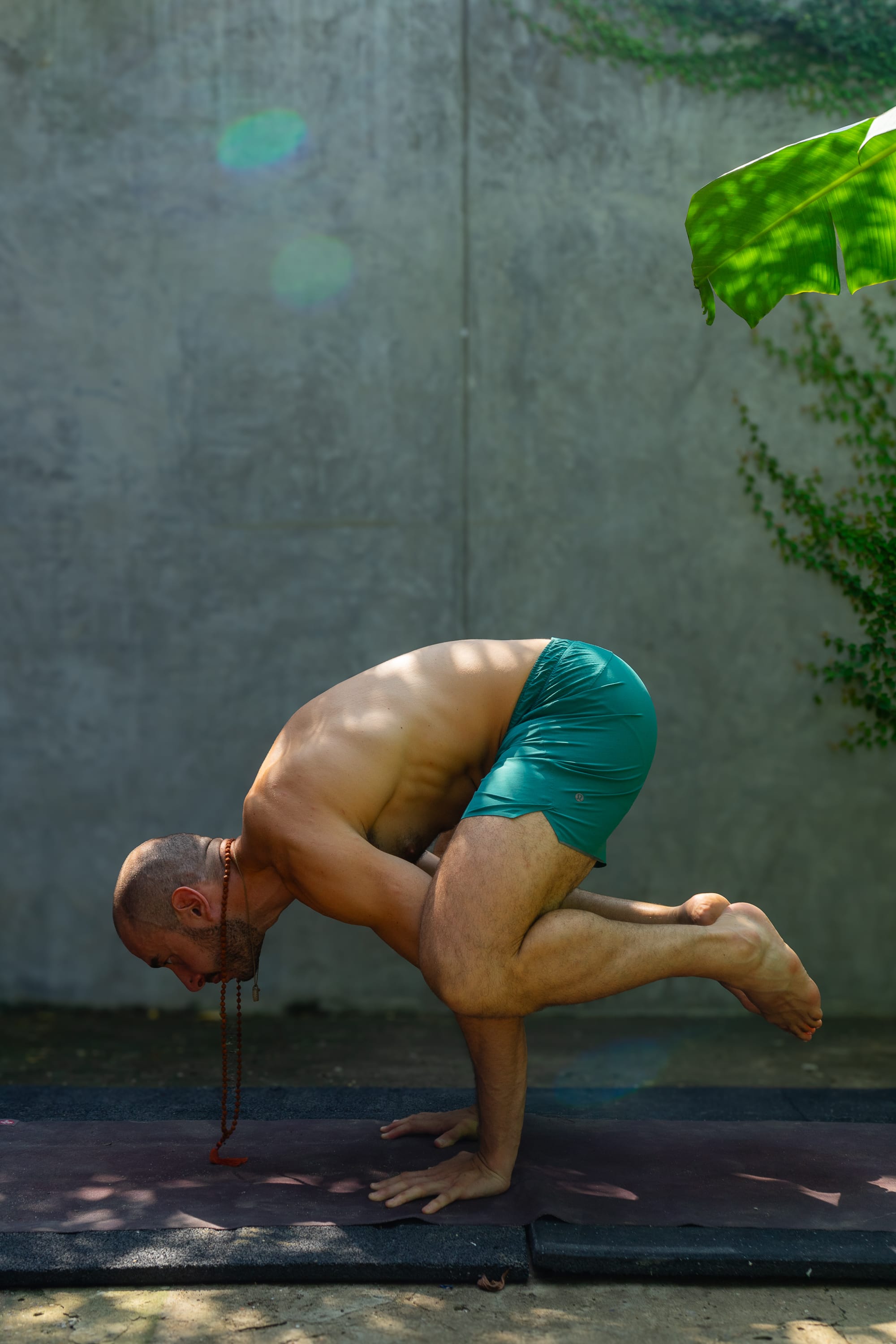
Yoga can be a great teacher. It can be far more than a physical exercise routine. We might feel intimidated and insecure in early classes when we notice the flexibility of others. I couldn’t sit cross-legged when I started and felt frustrated often, and sometimes still do.
Over time, yoga has become one of my most reliable tools for self-awareness, patience, and integration, alongside its physical benefits.
I completed a 200-hour yoga teacher training with Ancestral Academy. Within days, it became clear that this would be a month of introspection as much as instruction. It was exactly what I needed at the time, and now I understand that this is the purpose of yoga as a lifestyle - a journey inwards to remember our true nature.
If you are curious about yoga or want to deepen your existing practice, drop me a line. I love talking about yoga, and I offer 1-to-1 online classes that can empower you to develop your own personal practice.
Integrating our Energetic Polarities
Many cultures believe that every one of us contains two energetic polarities: our masculine and our feminine. These are not to be understood as gendered or dictate how we should behave or the qualities we have. They represent different qualities within us that, when fully integrated and balanced, allow a certain harmony between the world and the way we live our lives.
While referenced separately, they are complementary and interconnected. In Chinese philosophy, they are known as Yin Yang. In Hindu philosophy, Shiva Shakti. Because they should be taken as a whole, there is no "and" or & in the original language of either.
Many of us may be disconnected from healthy masculine energy, our Yang or Shiva. I exhibited many characteristics of what Carl Jung terms the puer aeternus, or the eternal boy. In psychology, the puer aeternus is a man who remains emotionally stuck in adolescence, full of potential but afraid of commitment, responsibility, and entrapment. The female equivalent is the puella aeternus. We start projects and leave them unfinished, or find excuses to avoid commitment in relationships.
Some of us, regardless of gender identity, may experience challenges connecting with our feminine energy, our Yin or Shakti. We are disconnected from our emotions and our bodies. Some of us learned - in our families of origin and through cultural conditioning - that it was best to hide sadness or anger or any other emotion. We are highly logical and think our way through life. We may find it difficult to tap into our creativity and playful nature.
Understanding and ultimately integrating these two energetic poles has been essential to bring balance into my life. I learned how to feel and express emotions, how to move my body and how to listen to my intuition. A breakthrough moment came when I sobbed openly in a room full of men at a retreat. I wore flowery leggings and got my nose pierced - symbolic yet important steps.
Learning what it means to be vulnerable beyond expressing raw emotion is an important step; vulnerable is not just crying or allowing our anger to surface. It can be acknowledging our fear of failure, of not being enough, of not knowing, and developing the ability to ask for help.
This is particularly problematic for men. It's widely reported that suicide is among the main causes of death for men. We bottle up our struggles and try to solve everything ourselves, leading to feelings of loneliness and isolation.
When I facilitate men's retreats, I have the honor of guiding men in their healing journeys and seeing their vulnerability. When I ask how many have friends at home they can be as open with, barely a hand is raised. We are yearning for this type of connection.
In mixed-gender retreat settings, some women have shared that encountering a steady, grounded masculine presence — calm, boundaried, and emotionally available — has felt unfamiliar and supportive, particularly where trust with men has been complicated or fractured. I don’t take this as something women need from men, but as something that can be meaningful in certain contexts when safety, choice, and agency are firmly held.
We need a culture where emotional expression and vulnerability are not treated as exceptions or crises, but as ordinary parts of being human. Much of my work is about helping people come back into relationship with their bodies, make sense of their emotional lives, take ownership of their part in relational patterns — without collapsing into shame or self-blame, and find or build forms of connection that don’t require them to perform, harden, or disappear.

Healing, Avoidance, and Spiritual Bypassing
As we step away from more obvious forms of numbing — substances, overwork, constant stimulation — we may begin to notice something else appear. It’s possible to become addicted to healing itself.
We can become fixated on getting rid of discomfort. We chase insight, catharsis, regulation, relief. We try to resolve feelings before we’ve actually felt them. This can look like growth. It can sound spiritual. And yet, it can be another way of running away.
I’ve fallen into this more than once. Having learnt how to feel, I would lie in the bath for an hour and try to rid myself of the feelings before my psyche was ready to let them go: “if I can just squeeze out this uncomfortable feeling, I’ll be okay”.
Spiritual bypassing doesn’t always look like denial. Sometimes it looks like urgency — the need to move on, integrate, transcend, be “done.” I’ve learned, slowly, that discomfort doesn’t respond well to being rushed.
Acceptance — telling ourselves “right now, it’s like this” — has been the only thing that’s ever actually worked for me.
Life will bring us to our knees. The people we love most will die. Relationships will end. Pain is inevitable; we don’t need to seek it out. The more we learn to stay with what arises — sadness, loss, grief — the greater our capacity to experience difficulty without collapsing, and as a result more we can embrace joy, happiness, and contentment. Our personal practices are how we train this capacity.

Stillness, Movement, and Restlessness
I lived my life chasing adventure and experiences. I travelled for nineteen months between university and my first job. I’ve lived in Glasgow, London, Bogotá, Mexico City, Tepoztlán, San Diego, and San Francisco. Three years is the longest I’ve lived in one place as an adult.
We often wear travel like a badge of pride, something that boosts our social status and makes us more interesting. I certainly did. Those experiences shaped me deeply and I’m so grateful for them. My desire to travel and experience different cultures will always be there.
Yet my travels also kept me in motion.
I now see that I was running and didn’t yet know how to be still. We rarely celebrate stillness, yet it’s one of the most powerful ways of knowing ourselves. French writer Blaise Pascal once said that "all of humanity's problems stem from [wo]man's inability to sit quietly in a room alone."
There’s endless stimulation available — media, dating apps, vacations, festivals. While it's wonderful to embrace all that's there, how comfortable are we with a book and a pot of tea, without our phones or a vape? Or a solo walk through the woods without a podcast? How do you feel in silence, no background music, no noise?

Teachers, Mentors, Community
We don’t walk this path alone. Learning how to ask for and receive help is an important step.
I like the Zen phrase “when the student is ready, the teacher will appear.”
When we open to the possibility that we’re not quite who we thought we were — that we’ve been living inside certain boxes — we often begin to encounter people who can walk alongside us.
It might be a therapist, a teacher, or a new friend. As we loosen our grip on old identities, friction can arise in familiar relationships. We may no longer feel nourished by friendships that once sustained us. That doesn’t mean abandoning them, but it may require making space for new connections.
You might find yourself spending more time alone, saying no more often. There’s usually an old people-pleasing part that finds this hard. The idea of empty weekends can feel unnerving. Loneliness isn’t pleasant.
Many of us realize that we need to get into a relationship with our loneliness. From that place, relationships become choices rather than solutions — entered into with more care, honesty, and agency. It can feel scary not knowing what will come after, but learning to stay with loneliness changes how and why we connect. We begin to build relationships that truly nourish us.

The Best Part of It All?
Here’s the thing. As we begin to understand and change our patterns, the shifts we’re capable of can be profound. We move from blame toward responsibility. We acknowledge what shaped us, feel what needs to be felt, and begin to trust ourselves again.
Life doesn’t become easier, but our capacity to meet it expands. We become more accepting of difficulty. We learn without skipping the emotions that come with change.
Eventually, we realise the work is never really “done”. That doesn’t mean endless therapy or constant healing. For a time, that phase may be necessary. Eventually, healing becomes living — and everyday life becomes the place where we practise, stumble, connect, and grow.
This work is not about getting rid of your neuroses or character quirks. It's not about permanently banishing anxiety or fear or shame. As desirable as that sounds, it's not realistic. It's about befriending the parts of ourselves we find challenging, rather than trying to push them away.
If you recognise yourself anywhere in this, this space is for you. I’m not offering answers or a finished map. What I’m offering is presence and perspective. I’ve walked into many of these places — sometimes willingly, sometimes not — and I’m still walking them now.
If you want someone alongside you as you choose how to move forward in a more honest and sustainable way, you’re welcome here.